
It’s been about a year since my last post comparing Rivian and Tesla’s production ramp, and I wanted to share an update.

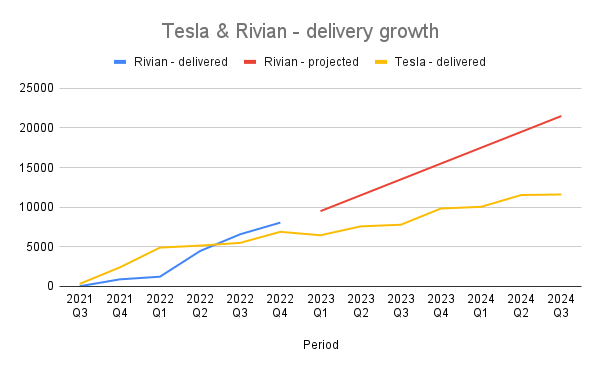
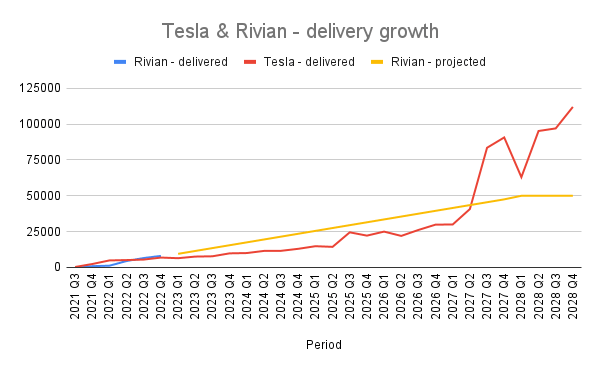
Specifically, this chart compares growth of deliveries quarter-by-quarter for each company based on when each started production (Tesla = 2012 Q3, Rivian = 2021 Q3).
Rivian continues to deliver more vehicles per quarter than Tesla at the equivalent point in development. Additionally, Rivian is producing three vehicles: the R1S (SUV), the R1T (pickup truck), and two sizes of delivery vans. Based on Rivian’s guidance for 2024 (purple dashed line on the chart), this will continue for probably at least another 6-12 months.
To be fair to Tesla, Rivian has taken advantage of Tesla proving that there’s a market for electric vehicles. Rivian was likely taken more seriously by suppliers because at least there was a new all-EV car manufacturer that had been founded in recent history.
Rivian, however, started production at possibly the worst time: just as the economy saw rocketing inflation and supply chain problems throughout the automotive sector. The effects of this certainly hit their early financial results, but they’ve been making great strides in efficiency and cost-cutting, particularly with the Generation 2 updated vehicles.
Looking forward to 2025-2026
Rivian is aiming to start production of R2 vehicles in the first half of 2026. This would mean that their lower-cost / mid-range vehicle would start deliveries approximately 3-6 months ahead of Tesla at the equivalent point in development.
Tesla started Model 3 deliveries in Q3 of 2017, which aligns to Year 6 – Quarter 1 in the timeline above. If Rivian starts deliveries in Q2 of 2026, that aligns to Year 5 – Quarter 4 on the same timeline.
With Rivian saying that they’re going to start R2 vehicle manufacturing at their existing Normal, IL plant, it certainly removes a lot of risk in achieving their goal of launching in the first half of 2026. There’s no risk of construction delays, no risk of poor knowledge transfer from experienced Rivian line workers, no risk of splitting effort across two very geographically-separated plants at a key milestone, etc.
That said, at some point Rivian will need to expand manufacturing space beyond the existing Normal, IL plant if they want to scale. (The existing plant can manufacture approximately 200k -ish vehicles per year; Tesla is currently manufacturing over 400k vehicles per quarter, over multiple plants.)
I believe the interesting test for Rivian will be their ability to ramp manufacturing in 2025. Will they be able to use the newly updated Generation 2 R1 platform to drive more throughput in manufacturing? How will preparations for manufacturing the R2 platform affect throughput?
Tesla was able to continue increasing production of the Model S and Model X in the four quarters before launching the Model 3. Will Rivian be able to do the same, or will they be limited by factory space in Normal?
As a Rivian fan, I’m looking forward to seeing how the company will execute. (And really hoping they’re able to pull forward product development on the R3X – that’s a really exciting car!)


 Jed Christiansen