In July 2012, I launched Seed-DB, a database of seed accelerators around the world and the companies in which they invested. I had originally started compiling the data in Google spreadsheets when I was writing my MBA thesis, and wanted to quantify the nascent accelerator ecosystem. Over time I kept getting feedback that the data was valuable to people, and decided to launch a standalone webapp to make it easier to access.
Building Seed-DB was a very meaningful milestone in my life. Building a webapp by myself was a fun challenge, and proved I could take an idea and implement it. (I have training in aerospace and nuclear engineering; not computer/software engineering, but taught myself how.) Over time, Seed-DB became an important resource for founders, accelerators, and others looking to understand the ecosystem. I’m proud to say that Seed-DB data was the source for infographics in the Economist and was cited in the New York Times and Techcrunch! (It also led to two different jobs.)
But everything must end, and it’s time for me to shut down Seed-DB. I haven’t had the time to update the data in a few years, even for the most high-profile accelerators. Additionally, the infrastructure behind the site needs a total overhaul, which I just don’t have the time or heart to do anymore. Finally, the seed accelerator ecosystem is just much more known – warts and all. The site isn’t as valuable or insightful as it was when it launched.
Thank you to everyone who’s given me feedback or who’s shared data with me – from accelerators to investors and founders themselves. I also owe a huge thank you to Crunchbase who gave me API access for many years to get the funding data that appeared on Seed-DB. Thank you to everyone for your support.
Over $5 billion in exits have already been achieved by accelerator graduates. Companies that have yet to exit are collectively valued at over $80 billion.
Early stage startups continue to be a power-law phenomenon. Despite funding over 6,000 companies in nearly 200 programs around the world, 75% of the investment dollars have gone into accelerator graduates of just four programs: Y Combinator, Techstars, 500 startups, and Angelpad.
That said, this stat isn’t as dramatic as it might appear. Those four programs have collectively funded over 40% of the 6,000+ graduates. Essentially, they’re prominent because they figured out ways to scale effectively, either through bigger class sizes or more frequent programs. Between these programs’ alumni and mentor networks, and reputational effects, they’re able to consistently find, fund, and mentor a higher-achieving tier of startups.
And while you obviously don’t have to go through an accelerator to succeed; it helps. Pitchbook found that one-third of startups that raised a Series A round in 2015 went through an accelerator. But only about 1,200 companies per year went through an accelerator in 2013, 2014, and 2015, and there were far more than 3,600 companies started each of those years. So while companies that go through an accelerator are a small portion of early-stage startups (likely 10% or less), they are a much larger percentage of successful startups (33%).
Why Seed-DB?
One of the big reasons I created Seed-DB is because the world of accelerators is plagued by anecdata. It’s easy to remember the accelerators that helped the B2C companies that you may use today; it’s harder to know about accelerators behind the B2B hard-tech companies that don’t get a lot of press but are growing like crazy. I also believe there are some great accelerators (or at least accelerators that have found great companies) that don’t get the attention they deserve.
For example, did you know the Flashpoint program at Georgia Tech funded two companies that have both gone on to raise over $100million each? Did you know the third biggest exit of an accelerator company (for $350million) came from AngelPad?
Seed-DB exists to give entrepreneurs the data on which companies have been through which programs, in order to make more informed choices. To answer the questions: is an accelerator right for me? Which accelerator is right for me? And why?
Seed-DB — relaunch
Today also marks a re-launch of Seed-DB! While the user interface hasn’t changed substantially (I’m not a strong front-end developer), the data structures behind the scenes have changed substantially.
Charts & Tables
Tabular data is valuable, but charts bring data to life. Seed-DB now has a dedicated “Charts & Tables” page to showcase this information. There are four key charts:
Total number of accelerator companies over time, updated monthly
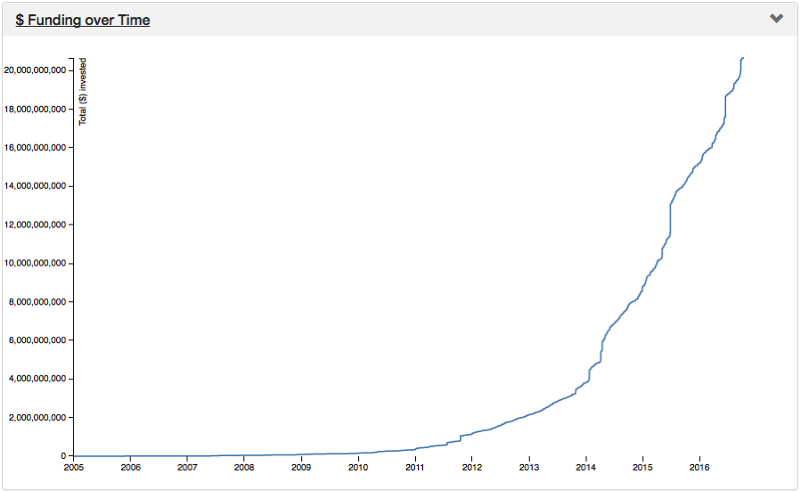
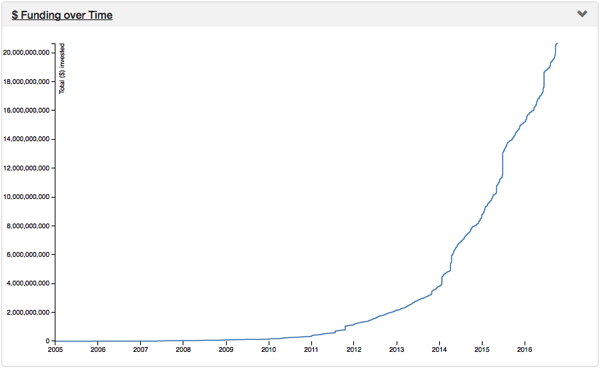
Total funding (in $) of accelerator companies over time, updated daily — now > $20 billion
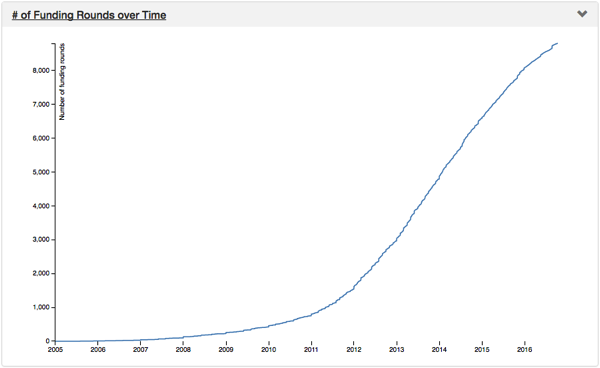
Number of funding rounds over time, updated daily
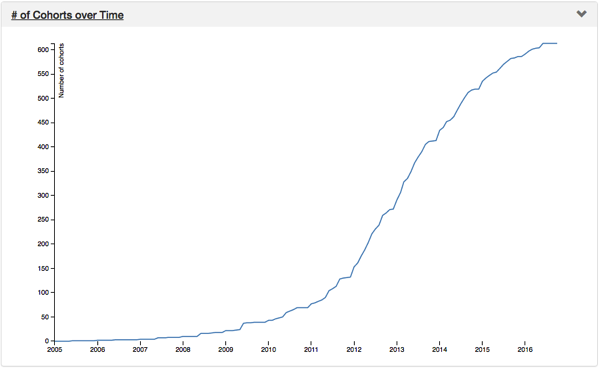
Number of accelerator cohorts/batches over time, updated monthly
Log/Log chart of company total funding (for companies that have raised >$500k)
You can see from these charts that there was a significant change in trajectory with more companies going through accelerators starting in 2011, which increased further in 2012. The chart of total funding has a significant trajectory change in 2014, which increased again in 2015.
The same page also has some of the most popular tables:
The biggest data structure change has been a pivot on accelerator cohorts or batches. Previously each accelerator was a flat list of companies they had funded, though Seed-DB did store the month they started with at the program. Now each accelerator shows the highlights of each individual cohort, and then you can drill down further to see individual companies in that cohort. (You can toggle back to the old view if you want, though.)
This is significantly faster for most users, but also shows a new layer of detail. It’s clear to see that one of the most successful YC companies to date (AirBnB) was in one of the smallest YC classes ever, in the middle of the financial crisis in Jan — Mar 2009.
Additionally, this cleans up the user experience for accelerators that run multiple programs in different cities or verticals. (Specifically, programs like Techstars, DreamIT Ventures, Startupbootcamp, Wayra, etc) Instead of each of these programs getting listed as separate accelerators, the various cohorts are all grouped together in one overall accelerator.
Sign Up for Updates
Interested in how accelerators progress over time? It’s been just 16 months for accelerator companies to raise $10 billion; would you like to know how quickly the next $5 or $10 billion is raised? You can now click Login, OAuth with Google or Facebook, and click one button to sign up for updates on when high-level milestones are reached. (Your email address won’t be shared, and updates will be infrequent.)
You can also sign up for the Seed-DB newsletter, which will have more analysis and long-form updates, and is sent even more infrequently.
Better on Mobile
While I won’t say Seed-DB is truly mobile optimized, the tables of data in Seed-DB can be used far more easily on mobile than they ever have before, and the new charts work great on mobile, too. (Thanks, d3.js!)
Patreon Campaign
Finally, I’ve kicked off a Patreon campaign to help support Seed-DB. If you find Seed-DB valuable for yourself or the startup community, please consider supporting the campaign! No funds will go to Jed; they will all be used to either pay monthly infrastructure costs, or go to contractors to help with data collection. In other words, any contributions only go to keeping Seed-DB running and improving data quality.
Personal Disclaimer: I did my first research into accelerators in the summer of 2009, and created Seed-DB in the summer of 2012. Two and a half years ago I started working for Techstars as a Product Manager. This post represents my personal views, and not those of Techstars. All data comes from Seed-DB alone.
Ten years after the seed accelerator model was pioneered, Seed-DB has now identified over $10 billion that has been invested in accelerator graduates. Over 200 seed accelerator programs around the world have funded nearly 5000 companies, and over 300 companies have already exited for a total of over $3.5billion. The total valuation of companies that have come through accelerators reaches in the tens of billions of dollars. If you don’t believe that accelerators are a relevant way for early-stage technology companies to get funding and started… you’re sadly mistaken.
The first accelerator, Y Combinator, only started ten years ago. Techstars’ first class was in 2007, DreamIT Ventures in 2008, AngelPad in 2010, and 500startups in 2011. Most of these only funded handfuls of companies to start. Those early starts have compounded to create a juggernaut of high-quality startups getting funding. And as mature growing companies are able to find plentiful later-stage capital in the current environment, large funding rounds are becoming commonplace. Here’s what’s happened over time:
Top accelerators are now brands themselves, and their stamp of acceptance and access to their networks is self-reinforcing. While $10billion in total funding is an impressive milestone, companies that have gone through accelerators comprise only a small portion of the total venture funded startup scene. There is a lot of space for their influence to grow.
Top tier programs
76% of all venture capital funding of seed accelerators go to graduates of just five accelerator programs: Y Combinator, Techstars, 500startups, Angelpad, and DreamIT Ventures. But there are three parts to this: quality, quantity, and longevity.
An accelerator needs to be of a sufficient quality in order to help their companies become investable. That accelerator needs to fund a relatively high number of startups in order to have a meaningful impact in aggregate. (Either by funding more per year, or steadily accumulating a portfolio over time.) The longer a program has been in operation the bigger their companies can grow.
This is not to say that new programs won’t break into this top tier… just that they need more time.
Funding — a Power Law in action
If you search for [venture capital] and [power law], you’ll see that venture capital is an industry known to follow a power law… and power laws encompass the phenomenons of the “long tail” and the Pareto principle (aka 80–20 rule). This holds true for the world of seed accelerators, too. The following is a chart of the funding that the 939 companies that have raised the most venture capital after going through an accelerator (so ~20% of all accelerated companies).
This is a pretty extreme power law; Dropbox has raised over $1billion in funding alone, but hundreds of companies have raised between $1million and $10million in funding. (And thousands have raised seed rounds of <$1million). Let’s see what happens when we check for a real power-law relationship by plotting both axes on log scales.
The result is a straight(-ish) line, which means venture funding of accelerator companies is a power law relationship. (The math to prove it is fairly complicated and outside the scope of this post.)
But… do accelerators accelerate?
This is a very difficult question to answer. Luckily there are some very smart researchers trying to quantify this. Ben Hallen, Chris Bingham, and Susan Cohen have done some great work in trying to answer this question. Essentially they’re trying to determine if companies that have gone through accelerators reach key milestones faster than companies that haven’t gone through accelerators.
They haven’t yet published their paper, so I’m not going to steal their thunder. But their work should put the analytical horsepower to confirm (and disprove) various theories on accelerators.
All data on company funding comes from Crunchbase. Some companies don’t enter funding information in Crunchbase, and others don’t even have Crunchbase pages; in those cases the total funding would be even larger. Additionally, I know a number of accelerators have funded companies that aren’t yet listed on Seed-DB; I continually work with programs to help make sure data is accurate but inevitably the data for many companies will be missing.
Also, I pulled the data above earlier this week in order to write this post; it’s already out of date with the funding rounds raised this week. (Three Techstars companies announced over >$100million in funding within 48 hours this week, for example.)
Personal Disclaimer
I did my first research into accelerators in the summer of 2009, and created Seed-DB in the summer of 2012. One year ago I started working for Techstars as a Product Manager. This post represents my personal views, and not those of Techstars. All data comes from Seed-DB alone.
And the circle of self-promotion closed, as Seed-DB was promoted on Product Hunt, driving people to see the YC listing on Seed-DB, which showed users that YC’s class had Product Hunt in it.
What does this mean for stats? Well, let’s go to Google Analytics. Here are the hourly pageview stats for the week on either side of trending on Product Hunt:
I think the first spike came after initially trending on Product Hunt, and the second spike came after the Product Hunt daily e-mail was sent. How does this compare to Seed-DB’s traffic across the year? Well, it was by far the biggest spike:
And here are the stats from the “referral” acquisition channel for a week on either side of August 19th. Product Hunt drove over 2000 people to Seed-DB:
Since then…
Product Hunt has grown massively since then, and would now probably drive an order of magnitude more traffic for the top trending products. For me, August 19th was a bit of a surreal day but was pleased about the coincidence in the timing.
I was recently going over the statistics, and Seed-DB has grown virtually every metric by 30–40% compared to 2013. While I could look at that in startup terms and say “meh”, because I don’t do any marketing of the site I’m pleased that more and more people are finding it and finding it useful. I’m going to be adding a few key features in the coming months, so please stay tuned!




 Jed Christiansen