I’m pleased to announce the launch of Bayes Calculator – a passion project I’ve wanted to build for years. I created it to help people understand and visualize Bayesian statistics and Bayesian inference calculations. Check it out now at bayescalculator.com.
It’s been so long I don’t even remember when I was first introduced to Bayesian statistics, but I believe it was when I got my masters’ in Decision Sciences at the London School of Economics. While frequentist statistics was what I’d always learned growing up (and which is obviously still valuable), learning about Bayesian approaches filled a gap I hadn’t known existed.
Since I finally shut down Seed-DB last year, I’ve finally had some time to build the projects that have been kicking around in my head – this is the first to launch. There are a lot of features I’d like to develop, but in the spirit of “launch early” (and often?), I’m posting about it now, and I welcome any and all feedback. [Contact page or tweet at me.]
(I’d like to thank the newest crop of AI tools, without which it would have taken me easily 100 times as long in order to get this off the ground!)
The 2024 NYC marathon was my fourth marathon, where I effectively dropped ten minutes off my personal best. And the reason is simple – I finally realized I needed electrolytes! I’m writing this to share what I’ve learned to help anyone else in the same situation.
Quick background
In my previous three marathons, I ran into the same problem – around mile 20/21, I hit the wall and had to start walking periodically for the rest of the race. It just felt like my body fell apart, and I always chalked it up to “that’s what hitting the wall feels like.” This got increasingly frustrating – even when I really controlled my pace in the first part of the race on a particularly easy (downhill!) course, this still happened.
Luckily, I’d been working online with a coach (HUGE shout out to Matt Day from McMillan) and he pointed out that I needed to think about electrolytes!
(This is where I should point out that I’d only ever drunk water on long runs & races – I avoided any electrolytes because I never wanted to drink something that I hadn’t used in training. Nothing new on race day!)
Fueling with carbs – what I was already doing
In the course of training for previous races, I’d already figured out how to get the carbs I needed. I learned to properly eat / carb load in the day or two before long runs (say over ten miles). I also learned about running gels and got into the habit of ingesting a gel about every 30 minutes in a long run or race (starting about an hour in). This approach worked. [Runner’s World article detailing this]
Fueling with electrolytes – the missing piece of the puzzle
My coach Matt pointed me in the direction of a free online calculator to help me understand what I needed – check it out here. My results:
With my existing gels, I was 44g of carbs per hour already – a good chunk of what I needed. And I had been fine with overall fluid intake – that 15 oz/hour was probably what I was getting at the water stations.
HOWEVER! The gels I had been were only giving me ~100 mg of sodium per hour – just 20% of what I needed. (1000mg/32oz = 500mg/16oz, so ~500mg/hour)
The NYC Marathon offers Gatorade Endurance Formula Lemon Lime drinks at aid stations. When I looked up the key stats, I saw that this provides (per 12 oz):
300mg of sodium
22g of carbs
Additionally, I found alternate gels – Gu Roctane Energy gels – that would provide 250 mg/hour of sodium (versus the 100 mg/hour from my previous gets).
Putting this together, if I drank about the same amount (roughly 12-15 oz of fluids per hour spread across various aid stations) and used the Roctane Energy gels, I would be taking in:
66 g of carbs per hour (44 from gels, 22 from Gatorade)
550 mg of sodium per hour (250 from gels, 300 from Gatorade)
Results – the 2024 NYC Marathon
For the first time ever, I ran an entire marathon without needing to walk a step!
I’ll confess as I got to miles 20 and 21 in the Bronx, I was pretty anxious – this was the point in my previous marathons (and training runs!) where I had previously hit that wall. But as I got through those miles and crossed into Manhattan I got increasingly confident that I’d solved this problem and was ready to go. (Seeing my family cheer me on around mile 22 was also a huge mood lift!)
Instead of falling apart on Fifth Avenue as the hill rises along Central Park, I felt strong! I was energized as I passed loads of people, including those other runners that were forced to walk. Those final miles in Central Park to the finish were electric – I felt strong and the race photos with some of my biggest smiles are along this stretch of the course.
Instead of my body feeling like I was on the ragged edge (despite my legs feeling fine), I ended the race feeling strong… but with very tired legs!
Going forward from here
I’m honestly much more excited to run more marathons in the future – being able to crack this bonking problem is incredibly motivating! Now that I know I can finish strong, I can train with a new purpose. And I know I’m absolutely capable of dropping a lot more time off my new marathon PB/PR.
I’m definitely going to tinker with the specific gels and electrolytes I use, when I take them, etc. Toward the end of the race I was getting annoyed by always taking electrolyte, and could/should have taken water once or twice instead. But I’ve found a solid platform of an approach that will serve me well.
I’m writing this because there are a bunch of resources about getting carbs during the race, I haven’t seen the same about electrolytes. If you feel like you’re fit enough to run a full marathon but have had problems “hitting the wall” harder than you like, I strongly encourage you to use a calculator like I did and figure out if you need to change your approach to electrolytes in your racing.
The US Senate is a particularly powerful body of the US Congress. The most long-lasting power that the Senate has is to confirm judges to federal courts, including the Supreme Court. If the US has any hope of moderating the current 6-3 very conservative Supreme Court that has started taking existing rights away from American citizens than it’s critical for Democrats to maintain control of the Senate.
The Trump administration did great damage to the judicial system by specifically nominating and confirming a huge number of extraordinarily partisan judges. Only a Democratic-controlled Senate can fix this damage.
The Senate is also unique in that it’s a touch more moderate than members of the House of Representatives. Because Senators are elected state-wide, elections in states that are “purple” (neither far-right nor far-left) can be really competitive.
I’m working to help Democrats maintain and expand their control of the US Senate – and I’d like your help. I’ve created a fundraising page to help channel funds to these critical Senate races and have already raised nearly $300,000. But if you are willing to donate money to the races that have some of the highest policy return for your donation, consider donating today. And if possible set up a recurring donation, which allows the campaigns to plan and make better long-term investments today.
Funds will go to the eight seats with the closest margins that will determine control of the Senate. They are:
I’ve had… extensive experience with solar power, dating to my years building and racing solar powered cars with the University of Michigan Solar Car Team. One of the great things about having a home in Northern California is that I was able to take advantage of the weather to install solar panels and get to net zero energy use from the grid. This post is my story, and I strongly encourage you to check out switching to solar power for yourself. (Some of the details may be different in different states.)
Why consider solar power?
In short — why not? Solar energy is getting to your roof anyway – if the cost of panel installation (divided by the number of years they’re useful, generally 20+) is less than what you pay for electricity, then it makes sense.
More importantly, going solar means that (on net) you’re NOT taking electricity from the grid, which means you’re not contributing to greenhouse gas emissions from power plants. That way by far my biggest motivation in going solar.
Federal tax incentives are also key to making solar power very affordable for many homes – because if your system is installed this year, you get 26% of the cost of your entire system back as a federal tax credit. (If you wait until 2021, it goes to 22% and then 10% permanently after that, unless rules change.)
Will solar work for me?
The quickest way to find out if solar power will work for you is to use Google’s Project Sunroof website. You’ll need just two things: your address, and a rough estimate of your monthly electricity bill.
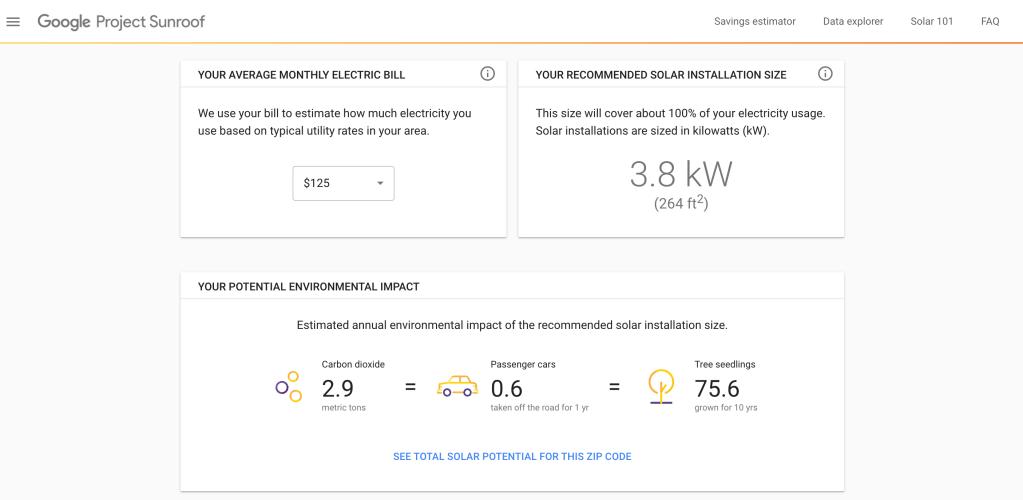
Google takes a look at your roof, the trees around your home, and historical weather to figure out how much sunlight actually reaches your roof, and how much roof area is available for solar panels. What you’ll see (in addition to a heatmap of where sun hits your roof) is something like this:
You can see that 100% of this home’s electricity can be generated by solar power (upper-right box), and going solar is the equivalent of stopping 2.9 metric tons of CO2 emissions.
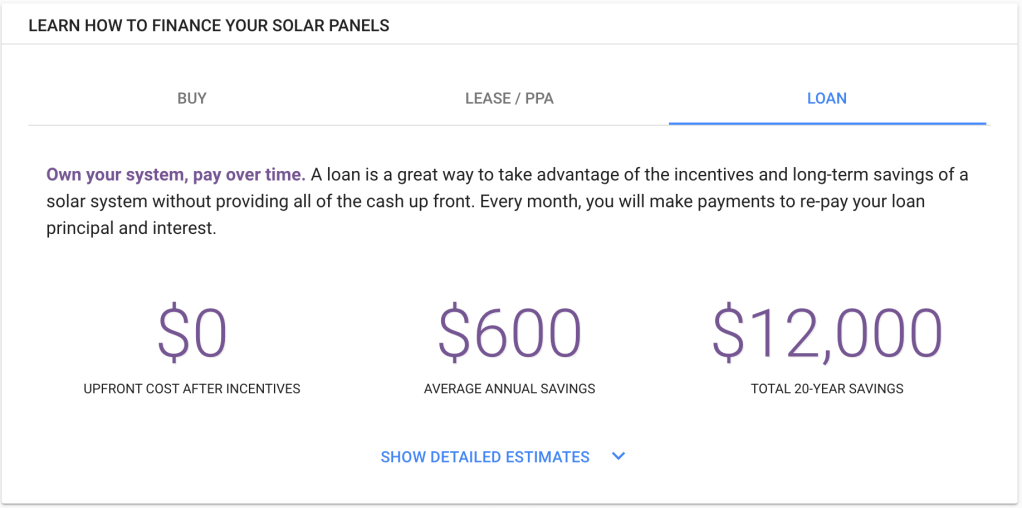
Project Sunroof also gives you an early indication of the savings and payoff period for your investment. They offer options for Buy, Lease or Loan. And here’s the kind of savings a random home in Northern California might expect:
Buy
Loan
So installing solar on this sample house means you could save $12k-$22k over 20 years, in addition to being a very positive benefit for the environment.
How to get started with solar for your home
So there are a ton of different ways to get started, but I’ll recommend two: PickMySolar, and direct with Sunpower.
PickMySolar / Solar.com – PickMySolar / Solar.com is a portal that makes the whole solar process easy. Instead of having parallel conversations with a number of different installer companies, they help you define the exact system you want, and then the installers bid (compete) for your business. (Note, the link there is a referral link, but by using it you should save $250 on any system you install!) I know some people who have had great experiences with them.
Sunpower – Sunpower designs and manufactures their own solar panels, and has a network of installers in the US they work with. I’m partial to Sunpower because they were very supportive of solar car teams back when I was racing in university. (The link there is also a referral link – I’m not sure if there are any savings with it, though.) They build very high-quality panels, and also use an architecture (inverters on every panel) that have some advantages.
In the end, we ended up going through Sunpower to design and install our system. It’s a long story, but our house has a complicated set of roof panels and only Sunpower could design a system that met 100% of our home’s energy needs, that was within building/fire code, and at a cost that meant that meant we were still saving money. The exact installation company we used was All Bay Solar, who did a great job. (You can also just contact them directly.)
How to pay for solar
We only really considered two options for solar: Buy vs Loan. Leasing can get a bit complicated if you ever sell your home, and I personally prefer owning assets like this.
We ended up going with a loan, mainly to avoid a big cash payment, but we do plan on paying it off well ahead of time. And even though our solar installation was about as complicated (aka expensive) as it can get on a home, our loan payment is about the same or less than our average electricity bill. More importantly, that loan payment is locked in while electricity rates may very well increase a fair bit in the next 10-20 years. (And once the loan is paid off, electricity is essentially free.)
For those curious about these things, the loan is completely separate from our mortgage. The solar loan is backed up by the panels/inverters/etc. themselves. So if we ever stopped paying, they have the right to repossess the panels, but that’s it.
Living with solar
There’s basically no difference to life with solar power, other than an extra box or two near our electric panel. When you install solar, you change your contract with PG&E (Pacific Gas & Electric) and go to a Net Energy Metering (NEM) agreement. Instead of getting a bill every month, PG&E looks at your energy use across the entire year.
If at the end of the year you’ve taken more from the grid than you’ve put in, you pay the difference. If at the end of the year you’ve contributed more from the grid than you’ve taken out, PG&E pays you. (PG&E does calculate peak/non-peak rates separately.) That said, you’ll owe PG&E roughly 21 cents per kWh if you owe them, but if they owe you they are only required to pay 2-4 cents per kWh. They give you a running estimate of what your bill will be at the end of the year.
But where I definitely see a difference is when I log into pge.com. Here are a couple of screenshots of what we see now:
Monthly view
Even on some of the hottest days (while running air conditioning) we’re a net contributor to the gridJune has been pretty hot so far, and even with air conditioning we’re still generating more than we use.
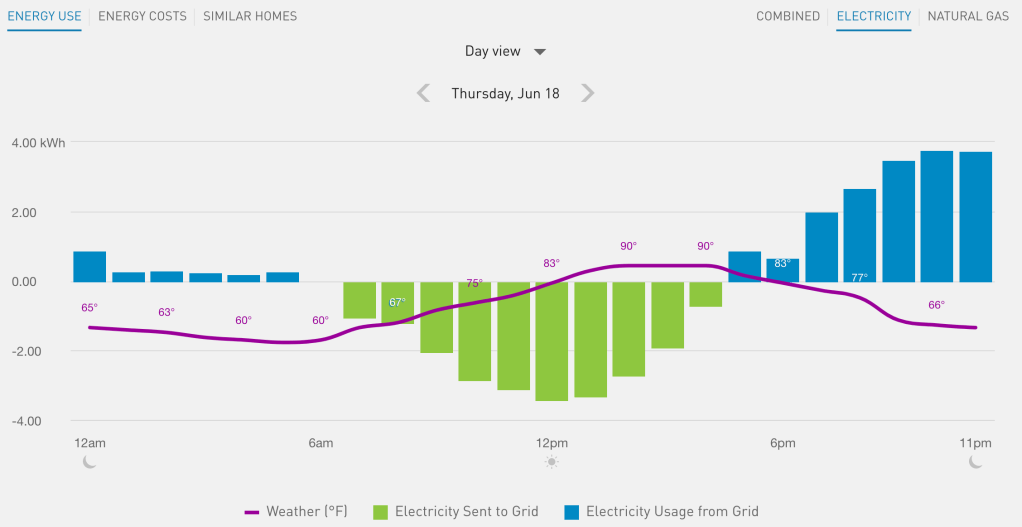
Daily view
Distribution of power over the course of a dayThis was a much hotter day (see the 90-degrees in purple?) – so more evening A/C use
Sunpower app
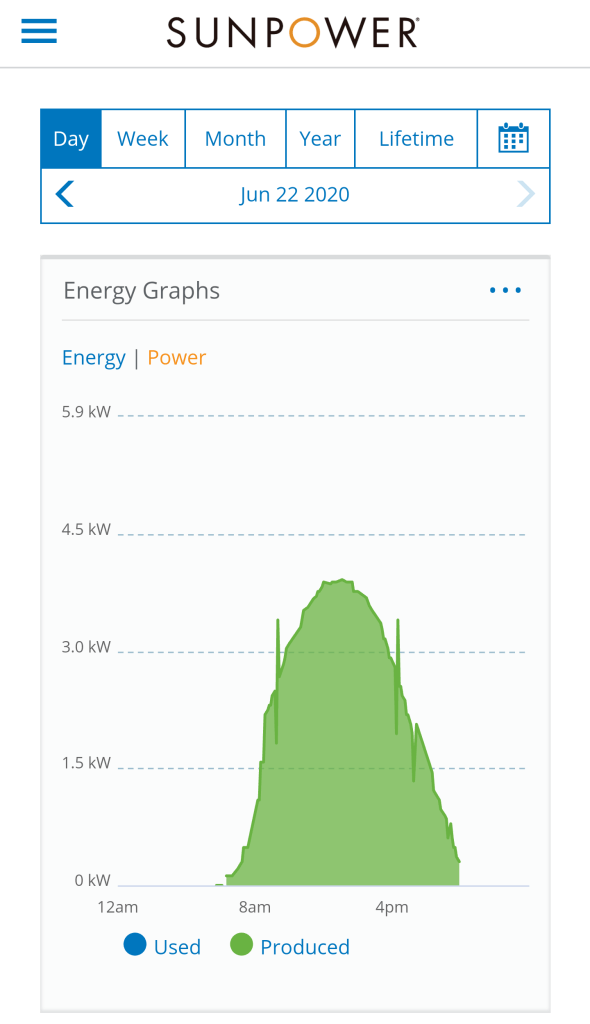
Sunpower has an app where you can see live and historical data for your home. (I believe other systems can do this – I’m just familiar with Sunpower.) I’ve essentially become an amateur tracker since I can directly see how clouds affect the power being generated by our system!
Today’s power – still generating at 8pm!
The other interesting effect I’ve seen is that I’ve become much more conscious of our electricity use at home. I’m much more militant about turning lights off, opening windows to get a cool breeze instead of using air conditioning, and more.
Summary
If you own a home – anywhere in the US – you owe it to yourself to at least check out Google’s Project Sunroof and see if solar is an option for you. And if there’s a chance to both save money and help save the environment at the same time – please take it!






 Jed Christiansen