I’ve updated the charts so they’re more clear on the timeline
I’ve added Lucid Motors as an additional comparison
Production Ramp Data
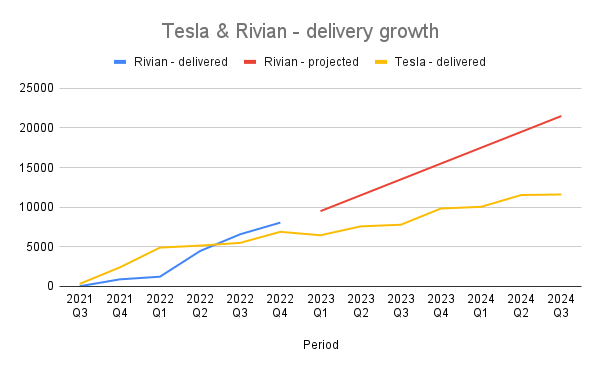
Rivian continues to outpace Tesla’s production at the equivalent point in their histories, delivering >12.5k vehicles in Y2Q4, compared to Tesla’s production of >7.5k vehicles. Rivian also continues to state they’re on track to produce 50,000 vehicles in 2023, which is modeled with the “Rivian – projected” line in the chart below. (In a very naive sense of “modeled”.) Rivian should continue to outpace Tesla’s manufacturing benchmark for many quarters to come.
Lucid Motors unfortunately continues to lag behind both Tesla and Rivian at the equivalent point, only delivering 1404 vehicles in the last quarter. At the same point in their history, Rivian delivered >7900 vehicles and Tesla delivered >6400 vehicles. Lucid’s vehicles seem to be pretty fantastic and I’ve definitely seen some on the roads in the SF/Bay Area. I sincerely hope they’re able to grow.
The thing I’m perhaps most excited about for the future of Rivian is that they’re producing at least 4 different vehicles across 2 different platforms. Consumers can purchase the R1T (pickup) or R1S (SUV), and Amazon is purchasing thousands of delivery vans across two different models. At the same point in their history, Tesla was only producing the Model S.
That Rivian has managed to continue a production ramp despite the complexity of multiple vehicles and platforms speaks well to their future ability to manage a growing family of vehicles and options.
Not a neutral observer
I need to admit I’m not a neutral observer. A long-time good friend of mine was an early hire at Rivian so I’ve had positive feelings for the company for years. Also, I’m one of those 12.5k deliveries for Rivian in Q2 2023! My wife and I took delivery of our R1S (Forest Green, Forest Edge interior, 21″ wheels) in May, and we absolutely love it.
Tesla and Rivian are the two biggest new car companies producing electric vehicles in the United States, and I recently thought it’d be interesting to compare their production ramps over time. As a massive proponent of electric vehicles and electrification generally, I think comparing Rivian to the benchmark growth rates Tesla has set can help shape an understanding of what’s possible for new car companies. (Obviously it’s different compared to existing car manufacturers, for a variety of reasons!) I also have a reservation for a Rivian R1S, but am generally interested in the success of any new EV manufacturer.
I’ll outline the relevant early history of both companies below, and then get into the charts. While Rivian took much longer from its founding to unveiling its prototype vehicles, it’s now on a much faster production ramp than Tesla was at the same point in its history.
Tesla
Tesla was founded in 2003, and the Tesla Roadster started production in 2008. But the Roadster was a vehicle that was produced in partnership with Lotus cars; the Roadster was a (highly) modified Lotus Elise chassis. When compared to scalable vehicle production lines, it’s just not the same.
The true car company history of Tesla arguably starts in 2010, when Tesla bought their Fremont factory from Toyota. This was needed for the Tesla Model S, which had already been unveiled in 2009, and which started production in 2012. The Tesla Model S was the only vehicle Tesla manufactured from mid-2012 to mid-2015.
Rivian
Rivian was founded in 2009. It purchased its factory in Normal, Illinois from Mitsubushi in 2017, and unveiled the R1T pickup truck and R1S SUV in November 2018 at the LA Auto Show. Amazon invested in Rivian in 2019 and announced a deal to purchase 100k electric delivery vans (EDVs).
Rivian started production in mid-2021. This production was across two platforms and multiple individual vehicles: the consumer platform (R1T and R1S vehicles) as well as the EDV platform.
Tesla vs Rivian – indexing production ramps
I went back to press releases from both companies to get data on vehicle production. Tesla started manufacturing and delivering Tesla Model S’s in Q2 2012, but only started reporting production numbers starting in Q3 2012. Rivian started manufacturing and delivering R1Ts in Q3 2021, but only announced 2021 full-year production numbers, so I’ve assumed ~5% of the full-year production happened in Q3, with the balance in Q4.
Sync’ing this up, Tesla started mass production/delivery in Q3 2012, and Rivian started mass production/delivery in Q3 2021, nine years later. (x-axis for the chart below is indexed to Rivian’s timeline)
Tesla vs Rivian – comparison
Tesla was able to very quickly ramp to deliverying 5,000 vehicles (specifically just the Tesla Model S) per quarter. But from then, growth was slower, taking eight quarters (two years) to cross the 10,000 vehicles/quarter threshold.
Rivian’s ramp in year one has been slower, taking five quarters (versus two) to cross the 5,000 vehicles/quarter threshold. But again, Rivian has been producing five different vehicles across two different vehicle platforms. This accelerated in 2022, and Rivian is also now on a much faster production ramp than Tesla was at the equivalent point in its history.
This is also on track to continue throughout 2023 and 2024. The red line above is my projections for Rivian growth, based on its expected 50,000 vehicle production in 2023 and extending that rate a bit further. (There are rumors that Rivian could potentially exceed this by 20% in 2023, too.)
Extending further into the future
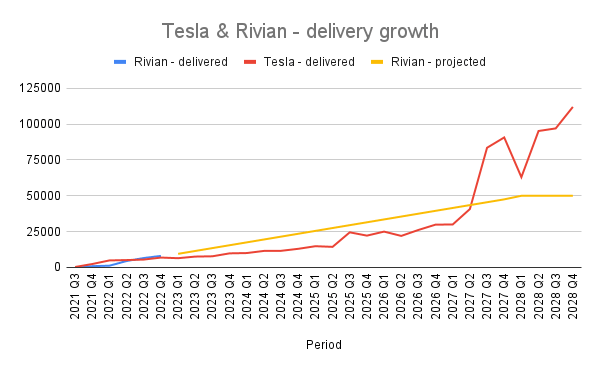
Rivian’s factory in Normal, IL reportedly has a maximum production capacity of 200k vehicles/year, or 50k/quarter. If we take the (very bad, possibly low-balled) assumption of the expected production ramp from 2023 into the future and compare it to Tesla, you get this:
Tesla started scaling massively with the launch of the Model 3, which began deliveries in 2017 Q3. Just one year later (2018 Q3) Tesla was manufacturing more Model 3’s per quarter than Model S’s and Model X’s combined. Indexed to Rivian’s timeline, this is equivalent to launching a new vehicle platform in 2026 Q3 and scaling it by 2027 Q3.
Interestingly, Rivian has already started construction on a new production plant in Georgia that (with the existing plant in Normal, IL) should allow the company to grow to 600k vehicles/year, or 150k vehicles/quarter. It has also stated that they expect to launch the R2 platform (lower-priced vehicles, similar to Tesla Model 3/Y) in 2026 and specifically manufacture it at this Georgia plant.
The next 12-24 months at Rivian will be interesting – will they be able to keep growing the production rate? How long will it take to get the maximum possible production from the Normal, IL plant? Right now Rivian is producing more vehicles per quarter than Tesla at the equivalent point. If the company is able to launch the Georgia plant and start manufacturing the R2 platform there in 2026 as expected, they may be able to continue to beat the production benchmarks that Tesla has set over the last decade.
It’s that time of year – college football bowl season. I’ve been a happy guy since my beloved University of Michigan Wolverines are 13-0 and in the College Football Playoffs as the #2 seed!
But let’s face it… not all bowl games are as prominent or prestigious as the Rose Bowl, the Sugar Bowl, the Orange Bowl, etc. Many bowl games are… Pity Bowls.
When I was growing up watching college football, bowl games felt relatively rare and teams only got to go to bowl games if they did well in their season — if they won. But it doesn’t take much to get invited to a bowl game these days… it’s a pity invite, and the games where these teams play each other are Pity Bowls.
Here’s the 2022 slate of Pity Bowls, where the bowl game just shouldn’t exist.
(exact schools not listed because it’s not their fault they got invited to a Pity Bowl.)
To be clear, the games that make up the Pity Bowl list are different each year. Sometimes an individual bowl will invite great teams; the games are on the Pity Bowl list above because neither of the teams they invited in 2022 have good records.
And yes, I know why these bowl games exist. TV stations/channels need to fill hours of airtime around the holidays, and live sports draws ratings, which means dollars. So even if two mediocre teams are playing a Pity Bowl, it’ll draw better ratings than a Law & Order re-run from 15 years ago or a re-run of a good bowl game from last year. But… it still sucks because it demeans the bowl games where the teams have actually done well.
So here’s my plea to whomever cares: college football (FBS) doesn’t need 40+ bowl games. Please, for the love of the game, just kill ten of these games so the ones that are left actually mean something.
The US Senate is a particularly powerful body of the US Congress. The most long-lasting power that the Senate has is to confirm judges to federal courts, including the Supreme Court. If the US has any hope of moderating the current 6-3 very conservative Supreme Court that has started taking existing rights away from American citizens than it’s critical for Democrats to maintain control of the Senate.
The Trump administration did great damage to the judicial system by specifically nominating and confirming a huge number of extraordinarily partisan judges. Only a Democratic-controlled Senate can fix this damage.
The Senate is also unique in that it’s a touch more moderate than members of the House of Representatives. Because Senators are elected state-wide, elections in states that are “purple” (neither far-right nor far-left) can be really competitive.
I’m working to help Democrats maintain and expand their control of the US Senate – and I’d like your help. I’ve created a fundraising page to help channel funds to these critical Senate races and have already raised nearly $300,000. But if you are willing to donate money to the races that have some of the highest policy return for your donation, consider donating today. And if possible set up a recurring donation, which allows the campaigns to plan and make better long-term investments today.
Funds will go to the eight seats with the closest margins that will determine control of the Senate. They are:



 Jed Christiansen